
Every new beginning starts with a choice.
Why Try Something New?
Trying something new is one of the simplest yet most powerful ways to grow. It expands your perspective, strengthens your confidence, improves creativity, and brings excitement back into everyday life. While staying in your comfort zone may feel safe, true growth happens when you step beyond what is familiar.
You don’t need to make a dramatic change overnight. Start small, stay curious, and remain open to new experiences. Every new skill, conversation, challenge, or adventure has the potential to teach you something valuable. The life you want may be waiting just outside your comfort zone. All you have to do is take the first step.
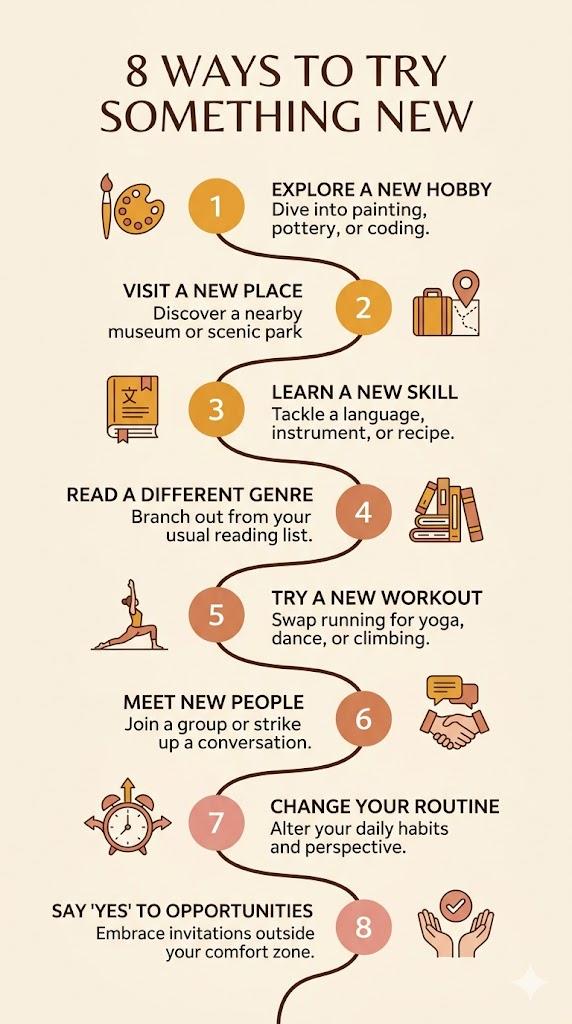
8 Way to try Something New why?
You know that feeling when your life looks exactly like it did last year? Same routine. Same choices. Same results.
You’re not broken. You’re not unmotivated.
You’re just doing the same things in the same way, and somehow expecting different outcomes. (That’s actually the definition of insanity, but let’s not judge ourselves too harshly.)
The secret to breaking that cycle isn’t motivation or willpower. It’s trying something new in a way that actually sticks.
Most people try something new and quit by day 3. Not because the thing is bad. But because they don’t know how to actually integrate new things into their life.
1 Start Stupidly Small (The Two-Minute Trick)
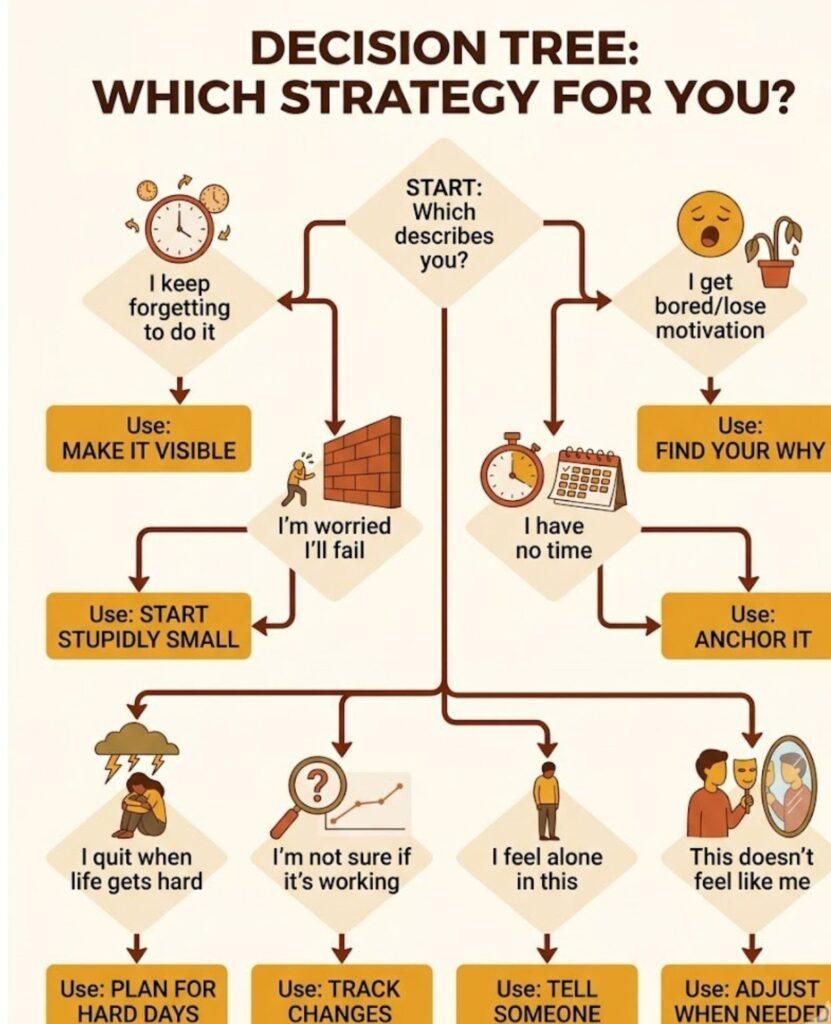
Problem: You want to meditate, so you commit to 30 minutes daily. Day 1 feels great. Day 3 you’re too busy. Day 5, you’ve quit.
The Solution: Start with 2 minutes.
Seriously. Not 10. Not 5. Two minutes.
A new practice doesn’t need to be impressive. It needs to be sustainable. Two minutes of meditation is infinitely better than 30 minutes of intention with zero follow-through.
Here’s why this works:
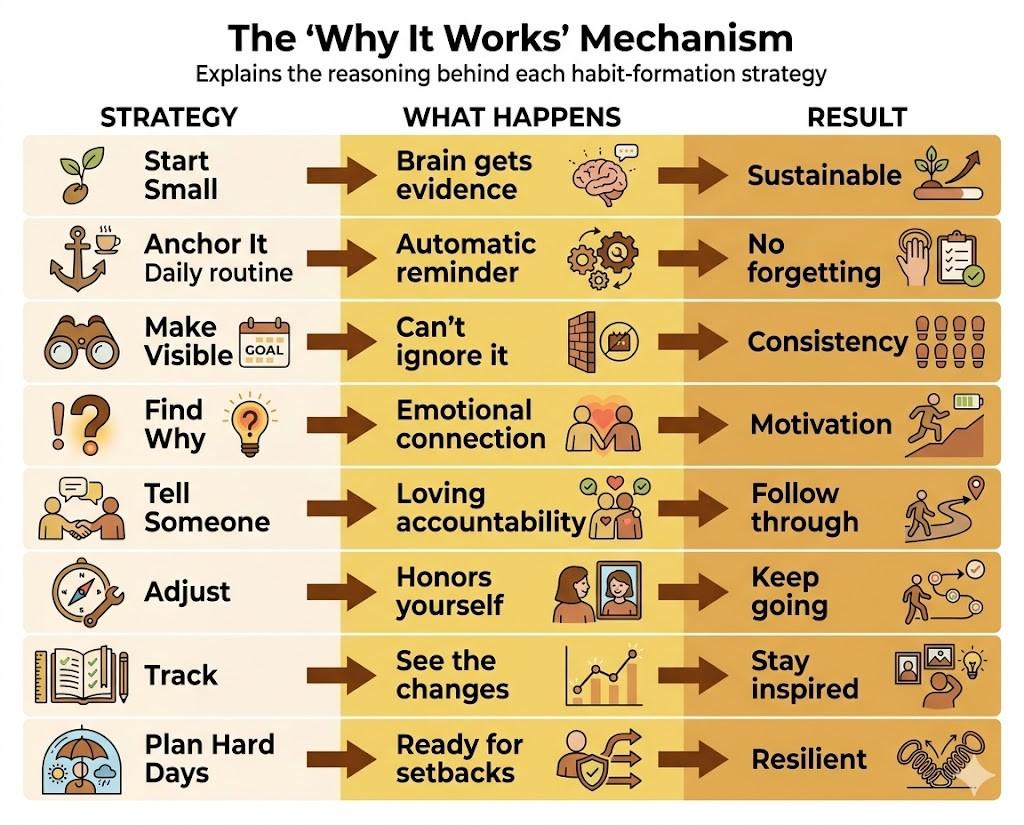
Your brain needs evidence that you can do this. Not evidence that you can do it impressively. Evidence that you can do it at all.
When you commit to 2 minutes and actually do 2 minutes every day for two weeks, something shifts. You’ve proven to yourself that you’re someone who meditates. That identity shift is more powerful than any grand gesture.
After two weeks of 2-minute meditation? You’ll naturally want to expand to 5 minutes. But even if you don’t, 2 minutes daily is better than zero.
How to apply it:
Take the practice you want to try
Shrink it to the smallest possible version
Commit to 30 days at that size
Let it grow naturally
The stupidly small version will feel almost too easy. That’s the point. Easy is sustainable. Sustainability is the goal.
2 Anchor It to Something You Already Do (Piggybacking)
Anchor It to Something You Already Do (Piggybacking)
The Problem: You want to start journaling, but you have no idea when you’re supposed to do it. So it doesn’t happen.
The Solution: Attach your new practice to something that’s already automatic.
This is called “habit stacking.” You take something you already do reliably and use it as a hook for the new thing.
Examples:
After you drink your morning coffee → write 3 grateful things
After you brush your teeth → do 2 minutes of stretching
Before you eat lunch → take 10 minutes for presence practice.
Right after you get home → one act of kindness (text a friend, help someone)
The key is picking something you’re 100% consistent with. Not “I usually remember to…” Use something automatic.
When you anchor a new practice to an existing routine, you don’t have to rely on remembering. The existing habit becomes the reminder.
How to apply it:
List 5 things you do automatically every day.
Pick one practice you want to try.
Attach them together
Do them as a pair for 30 days
Your existing habit becomes the foundation. The new thing becomes automatic by proximity.
3. Make It Visible (When You Can’t Miss It)
The Problem: You decide to practice gratitude. Then you forget. Then you feel bad about forgetting. Then you quit.
The Solution: Make your practice impossible to ignore.
Put a sticky note on your bathroom mirror. Set a phone reminder with a specific time. Create a visible tracker on your calendar.
The reason this works: out of sight = out of mind. Visibility creates accountability without judgment.
Some ways to make it visible:
Phone reminder at specific time (notification every day)
Sticky note where you’ll see it (bathroom, computer, car)
Calendar tracker (X off each day you do it)
Paper chart on your wall (old school but effective)
The visibility needs to be gentle. Not “YOU’RE FAILING” but “hey, remember this thing you decided to do?”
How to apply it:
Choose one way to make your practice visible.
Set it up today (not tomorrow)
Let it serve as your daily reminder.
Notice how much easier it is when you’re not relying on memory.
Visibility removes the need to remember. And that’s when new practices stick.
4. Find Your Why (The Real One, Not the Inspirational One)
The Problem: You want to be more present. Sounds good. But you don’t actually know why. So when it gets hard, you quit.
The Solution: Get specific about why you’re doing this.
Not “presence is good for me.” But specifically, who do you want to be more present with? What do you miss about them? How would deeper presence change your relationship?
When your why is specific and connected to something you love, the practice becomes easy. Because you’re not practicing for abstract self-improvement. You’re practicing for someone/something you care about.
Examples of real whys:
“My daughter asked me to listen to her. I want to be the person who actually listens.”
“I’m exhausted because my mind is everywhere. I want to feel peaceful.”
“My best friendships happened when I was fully present. I want that back.”
“I’ve been dishonest about small things. I want to be someone I respect.”
Notice the difference? These aren’t motivational quotes. These are real, connected reasons.
How to apply it:
Write down the practice you want to try.
Ask, “Why do I actually want this?” 5 times
Keep going until you hit something real.
Use that as your anchor
When you’re tempted to skip your practice, remember your why. Not the inspirational version. The real one.
5. Tell Someone (Accountability Without Shame)
The Problem: You decide to try something new. No one knows. No one checks. It’s easy to quietly quit.The Solution: Tell one person what you’re doing.
Not your whole social media feed. One person. Ideally someone who’ll actually ask you about it.
The magic isn’t judgment. It’s being seen. When someone knows you’re trying something, you feel a gentle accountability to follow through. Not out of fear. Out of self-respect.
Ways to do this:
Tell a friend, “I’m trying [practice] for 30 days. Can you check in with me?”
Text a buddy daily with your progress
Join a group doing the same practice
Tell your therapist/coach and report back
Share with a partner and ask them to remind you.
The person doesn’t need to be intense or pushy. Just present. “Did you meditate today?” is enough.
How to apply it:
Pick one person (not multiple, just one)
Tell them what you’re trying and why
Ask them to check in once a week.
Let their gentle accountability help you follow through.
Accountability works best when it’s loving, not shaming. Find someone who wants you to succeed.
6. Adjust When It’s Not Working (Permission to Pivot)
The Problem: You commit to yoga. But you hate yoga. So you quit. And then you feel like you failed.
The Solution: Pivot gracefully.
“New” doesn’t have to mean the exact thing you planned. It means trying something different from what you usually do.
If you hate yoga but want more movement, try walking. If you hate meditation but want more calm, try a tea ceremony. If you hate gratitude journaling but want more appreciation, try voice notes.
The practice should fit you, not some idealized version of who you think you should be.
Some reasons to pivot:
You hate it (life’s too short for practices you hate)
It’s not working for you (different people need different things).
It doesn’t fit your schedule (adjust, don’t quit).
You prefer a different version (there are 1,000 ways to practice anything).
Pivoting is not quitting. Quitting is giving up on trying something new. Pivoting is honoring what you’re learning about yourself while still trying something new.
How to apply it:
Try the thing for 1-2 weeks.
Notice: Do I actually like this?
If not, brainstorm alternatives in the same category.
Pick one and try that instead.
Give yourself permission to adjust
The goal is finding a practice that sticks. Not proving you can do one specific thing you hate.
7. Track What Changes (Make It Real)
The Problem: You practice for weeks. You feel slightly different. But you’re not sure if anything actually changed. So you stop.
The Solution: Write down what changes.
Not in an obsessive way. Just brief notes: “Felt more calm today.” “Got into an argument but didn’t yell.” “Noticed something beautiful I usually miss.”
When you track changes, they become real. You can see the actual difference your practice is making. And that keeps you going.
How to track:
Daily note (2-3 lines in notes app)
Weekly reflection (15 minutes each Sunday)
Scale 1-10 (How’s my peace level? my gratitude? my honesty?)
Symptom tracker (less anxious, better sleep, easier conversations)
The point isn’t perfection. It’s noticing. Most changes are subtle. Writing them down makes them visible.
How to apply it:
Keep a simple tracker (notes app works)
Each day, write one sentence about what you noticed.
After 30 days, reread them.
You’ll be amazed at the shift.
The changes are happening. Tracking just makes you aware of them. And awareness is what keeps you practicing.

8. Plan for the Hard Days (Not Just the Easy Ones)
The Problem: You do your practice for 2 weeks when life is calm. Then something stressful happens. You’re too tired. You skip. Then you skip again. Then you quit.
The Solution: Plan for the hard days before they come.
Most people plan for ideal circumstances. “I’ll meditate every morning when I’m rested and have time.” Then life happens and ruins the plan.
Instead, plan your minimum viable practice. The bare minimum you’ll do even on the worst day.
Examples:
Full practice: 20-minute meditation. Minimum: 2-minute breathing.
Full practice: Full yoga class. Minimum: 5-minute stretching.
Full practice: Long gratitude journal. Minimum: 3 things (can be simple).
Full practice: Deep presence with someone. Minimum: One genuine question.
When life gets hard, you don’t quit. You do the minimum. This keeps the practice alive and proves to yourself that you’re resilient.
How to apply it:
Decide on your ideal practice
Create a minimum version (1/5 the effort)
When stress hits, do the minimum
This counts. You haven’t quit.
When things calm down, return to full practice
The hard days will come. Having a plan means they don’t derail you. Minimum practice keeps you connected to your commitment.