

Happier Living Begins with Your Mindset
Wrong formula: Better circumstances → Happier mindset → Happier life (This never works because circumstances are always changing).
Right formula: Changed mindset → Different choices → Better circumstances → Happier life (This approach actually works because you’re the variable that changes.)
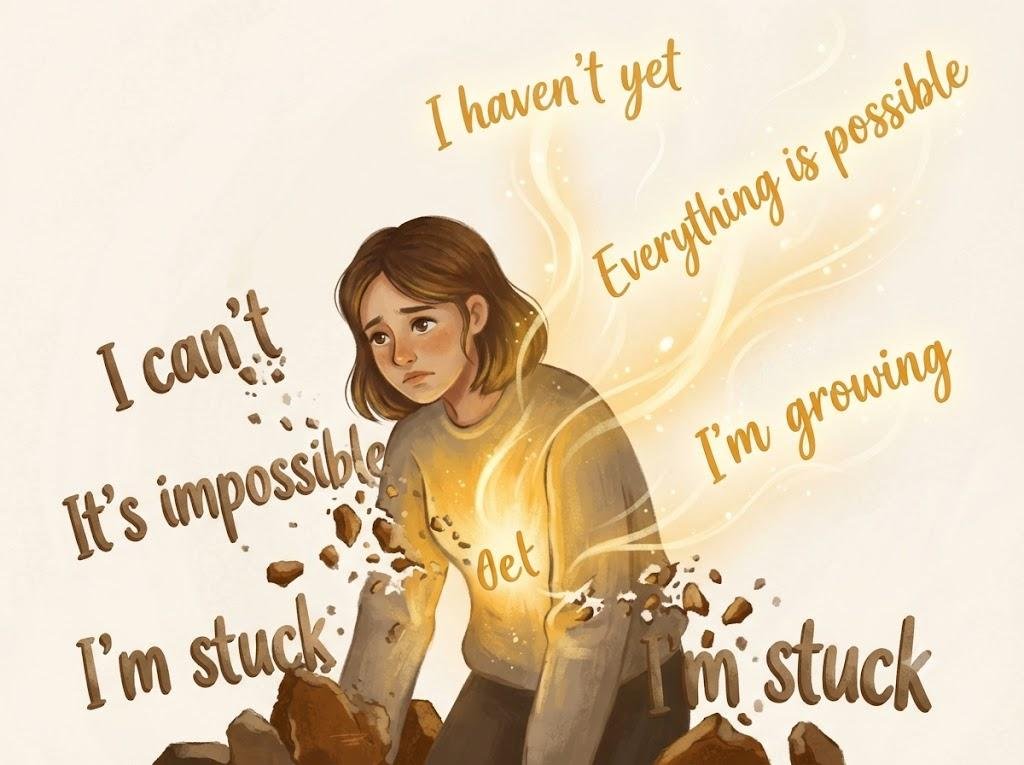
Happier Living your Mindset
Everything you do—every choice, every word, every action—flows from your mindset. Your mindset is like the software that runs your life.
If your software is programmed with “I’m not good enough,” you’ll unconsciously sabotage success. If your software says “I’m capable and resilient,” you’ll move forward even when scared.
Most people never examine their mindset. They just live from it. And then wonder why their life looks the way it does.
The Mindsets convert to happier living
Victim Mindset: “This Is Happening To Me”
In a victim mindset, you see yourself as powerless. Things happen to you. Life happens to you. Other people control your happiness.
What it sounds like:
“They made me angry.”
“I can’t help how I feel.”
“It’s not my fault.”
“I’m stuck because of my circumstances.”
“If only they would change, I’d be happy.”
Why it creates unhappiness: When you’re a victim, you’re powerless. You’re waiting for external forces to change. And you know what? External forces rarely cooperate.
The shift: Move from victim to creator. You’re not in control of what happens to you, but you ARE in control of how you respond. That response is where your power lives.
“This is happening to me” → “This is happening. How do I respond?”
Scarcity Mindset: “There’s Never Enough”
In a scarcity mindset, life is limited. There’s not enough love, money, success, opportunity, time, or happiness to go around.
What it sounds like:
“If they win, I lose.”
“There’s not enough for everyone.”
“I have to hold on tight, or I’ll lose it.”
“Other people’s success threatens mine.”
“I can’t afford to help/give/share.”
Why it creates unhappiness: Scarcity creates desperation, competition, and fear. You’re always stressed about not having enough. And scarcity is contagious—the more you focus on lack, the more lack appears.
The shift: Move from scarcity to abundance. There is enough. Not because circumstances are perfect, but because you decide to see what IS available rather than what’s missing.
“There’s never enough” → “There’s more than enough when I look for it.”
Blame Mindset: “It’s Someone Else’s Problem”
In a blame mindset, your unhappiness is always someone else’s fault. Your boss, your partner, your parents, society, and bad luck.
What it sounds like:
“They made me feel this way.”
“It’s their fault I’m unhappy.”
“If they were different, I’d be fine.”
“Life is unfair to me.”
Why it creates unhappiness: When it’s someone else’s fault, you can’t fix it. You’re waiting for them to change. Meanwhile, you stay miserable.
The shift: Move from blame to responsibility. Not “it’s my fault” (shame). But “I can influence this” (power).
Responsibility isn’t about guilt. It’s about agency. You get your power back.
“It’s their fault” → “I can’t control them, but I can control my response.”
Comparison Mindset: “I’m Not Enough”
In a comparison mindset, your worth is measured against others. Someone else is always doing better. Always prettier, smarter, more successful, and happier.
What it sounds like:
“They have it so easy.”
“I’m not as good as them.”
“I’ll never measure up.”
“Everyone’s life is better than mine.”
Why it creates unhappiness: There will always be someone ahead of you and someone behind you. If your happiness depends on being better than others, you’re on a treadmill that never stops.
The shift: Move from comparison to appreciation. Other people’s wins aren’t your losses. Their journey isn’t your measuring stick.
“I’m not enough” → “I’m exactly enough for my life.”
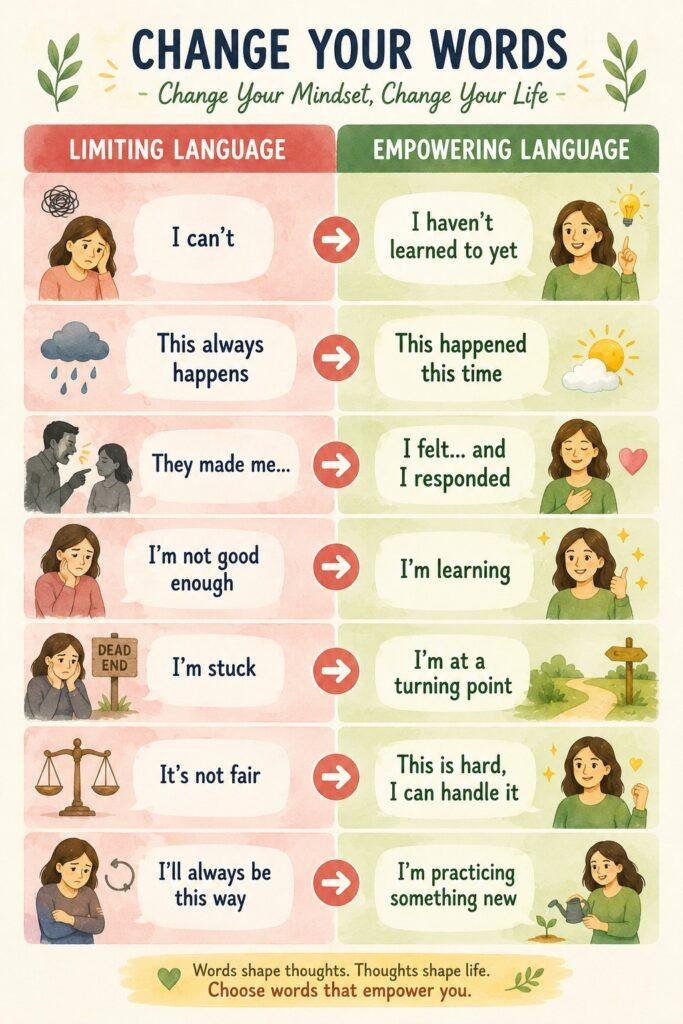
Fixed Failure Mindset: “I Can’t Change”
In a fixed failure mindset, you believe you’re unchangeable. You’ve always been anxious, always been negative, always been stuck.
What it sounds like:
“I’m just wired this way.”
“This is who I am.”
“I’ve tried everything; nothing works.”
“People don’t change.”
“I’m broken.”
Why it creates unhappiness: If you can’t change, why try? You’re locked in. The belief itself becomes the prison.
The shift: Move from fixed to growth. You can change. Not overnight, but with consistent practice, your brain literally rewires.
“I can’t change” → “I haven’t changed yet, but I can learn how.”
Possibility Mindset: “What If I Could?”
Instead of focusing on what’s impossible, a possibility mindset asks, “What if I could?” What if there’s a way I haven’t thought of yet?
What it sounds like:
“How could I do this?”
“What if there’s a solution I haven’t seen?”
“What would I attempt if I knew I couldn’t fail?”
“There might be a way.”
Why it creates happiness: Possibility opens doors. Your brain starts looking for solutions instead of obstacles. You move from stuck to exploring.
How to apply it: When you say “I can’t,” pause. Ask: “What if I could? How might I do this?”
Responsibility Mindset: “I Can Influence This”
In a responsibility mindset, you acknowledge that while you can’t control everything, you can influence your situation through your choices and attitude.
What it sounds like:
“What’s in my control here?”
“How do I want to respond?”
“I can’t control their behavior, but I can choose mine.”
“I’m creating my experience through how I think about this.”
Why it creates happiness: Responsibility is empowering. You stop waiting for rescue and start creating change.
How to apply it: When something goes wrong, ask, “What part of this can I influence?” Focus there.
Abundance Mindset: “There’s More Than Enough”
In an abundance mindset, you see the world as full of possibility, resources, and opportunity. Someone else’s win doesn’t diminish yours.
What it sounds like:
“There’s enough for all of us.”
“I can be happy for them AND happy for me.”
“Scarcity is a story, not reality.”
“The more I give, the more I have.”
Why it creates happiness: Abundance removes desperation. You’re not fighting for scraps. You can be generous, relaxed, and collaborative.
How to apply it: Practice noticing what you DO have. Every single day. Your brain will start defaulting to seeing abundance.
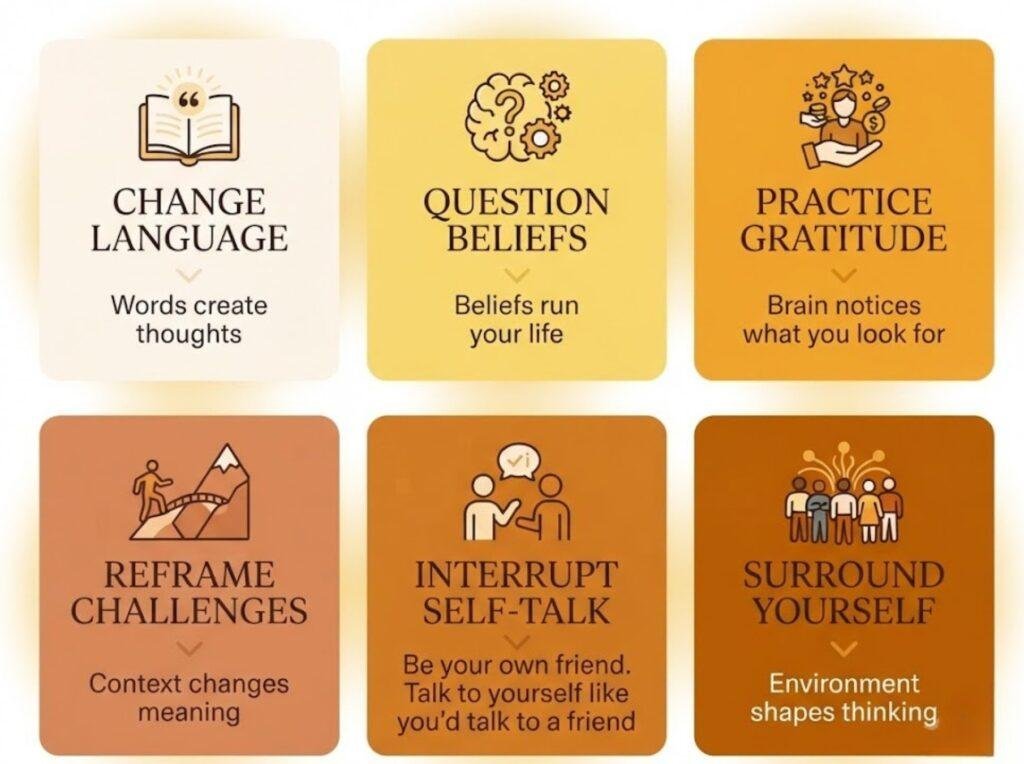
Growth Mindset: “I Can Learn and Grow”
In a growth mindset, challenges are opportunities to develop. Failure is feedback. Your abilities aren’t fixed—they’re developing.
What it sounds like:
“This is hard, which means I’m growing.”
“I haven’t learned this yet.”
“What can I learn from this?”
“Struggle means I’m at the edge of my ability.”
Why it creates happiness: A growth mindset removes the shame from struggle. You’re not failing—you’re learning. That’s the whole point.
How to apply it: When something’s hard, say, “This is where I’m learning.” Completely different feeling than “I’m failing.”
Compassionate Mindset: “I (And Others) Are Doing Our Best”
In a compassionate mindset, you extend kindness to yourself and others. You recognize that everyone’s struggling, everyone’s trying, and that’s enough.
What it sounds like:
“I’m doing my best with what I know.”
“They’re doing their best too.”
“This is hard, AND I can handle it.”
“I deserve kindness, especially from myself.”
Why it creates happiness: Compassion removes judgment. You stop expecting perfection (yours or theirs). You get to just be human.
How to apply it: When you mess up, notice your self-talk. Is it kind or harsh? Shift it to what you’d say to a friend.
🧠 Happier Living Mindset Quiz
Discover Which Mindset is Running Your Life (And How to Shift It)
You can’t change what you don’t see.
Your mindset is the invisible force creating your reality. It determines how you respond to challenges, celebrate wins, and navigate life.
This quiz reveals which mindset patterns are currently running your life—and gives you a clear path to shift toward happier, more empowered thinking.
🔍 What This Means
Loading…
💫 Your Strengths
Loading…
🌱 Areas to Develop
Loading…
🔄 How to Shift
Ready to develop a happier, more empowered mindset?
📖 Read: The Complete Guide to Happier Living Mindsets